
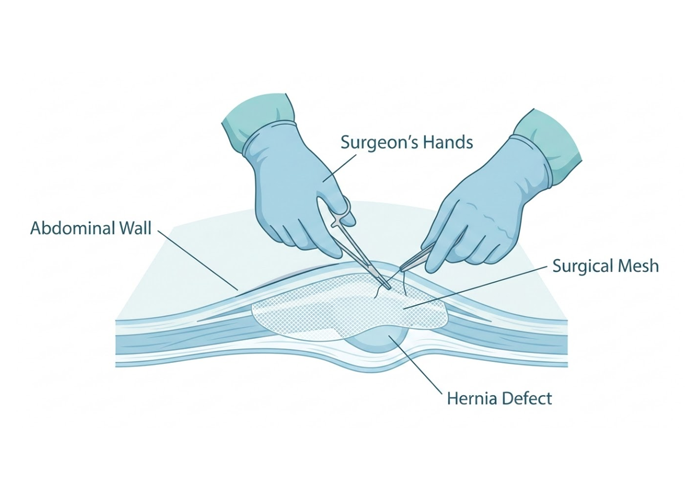
The so-called "open" hernia surgery is the classic method of hernia repair. In this approach, the surgeon directly exposes the hernia through a single incision, returns the protruding tissue to the abdominal cavity, and then reinforces the abdominal wall with a mesh implant. This technique remains extremely important in certain cases, even as laparoscopic or robot-assisted methods become increasingly widespread.
Why should open hernia surgery be considered in certain cases?
In elderly or high-risk patients, as well as in complex, large, or complicated hernias, or in patients who have undergone multiple previous surgeries, the open surgical technique can offer a distinct advantage and greater safety.
Advantages
- Safer in certain cases
- Shorter operating time (in many cases)
- Can be performed under local anaesthesia, spinal anaesthesia, or general anaesthesia
- Lower cost, does not require specialised or expensive equipment
Disadvantages
- Larger incision, larger wound surface
- Higher post-operative pain in the first days
- Longer recovery time
- Higher wound healing risk (infection, wound healing complications)
- Physical activity can only be resumed later
In modern surgery, the three methods (open, laparoscopic, robotic) complement rather than compete with each other.
The most common open hernia surgeries
For large inguinal – scrotal hernias
Lichtenstein repair
Shouldice repair
Mesh-free method – narrow indication for young patients with primary, small-to-medium inguinal hernias
For large, complex abdominal wall hernias
When reconstructing anterior abdominal wall or lateral/atypical hernias using so-called component separation techniques, the open approach is often the only solution. (The abdominal wall muscles are mobilised so that the abdominal wall can be closed again.)