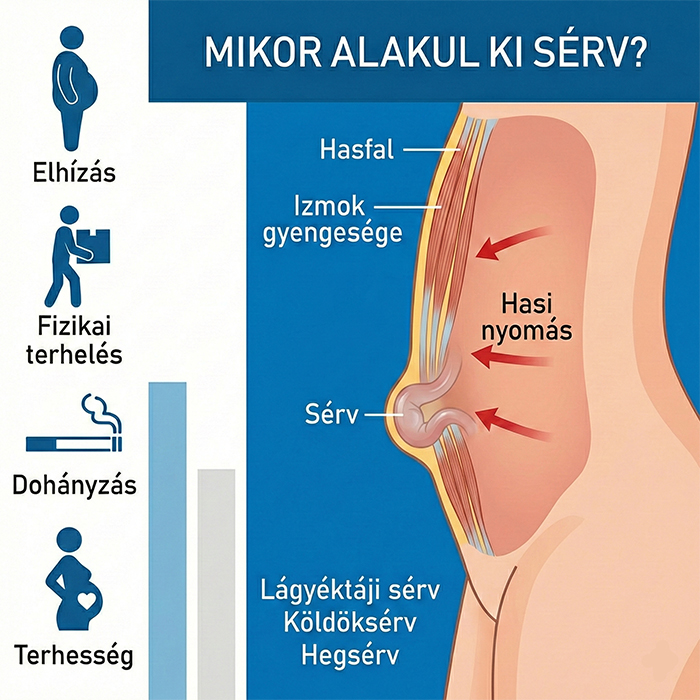
A hernia occurs when an internal organ protrudes from its normal anatomical position or cavity through a congenital or acquired opening. Hernias most commonly affect the abdominal wall.
How does an abdominal wall hernia develop?
The abdominal wall consists of overlapping layers of muscle, and the weakening or opening of these muscles, combined with increasing pressure within the abdomen, together contribute to the protrusion of abdominal organs and the development of a hernia.
In such cases, it is typically a segment of the small or large intestine, or the layer of fat covering the abdominal cavity, that protrudes. A hernia is not life-threatening in itself, but it cannot resolve on its own, which is why it is advisable to choose surgical intervention as soon as possible to avoid further complications.