
The selection and placement of hernia mesh is crucial to the long-term success of the operation. The position of the mesh is at least as important as the type of mesh itself.
I. Mesh implantation positions (by anatomical plane)
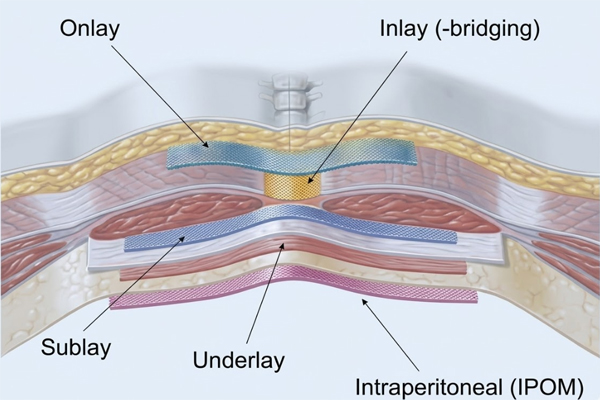
1. Onlay – placement above the external abdominal fascia
Outdated, not recommendedAn easy technique, but not the right approach! Now considered outdated and not recommended!
- ❌ High risk of seroma and infection, high recurrence rate
2. Inlay (bridging) – placed within the hernia defect
To be avoided- ❌ High recurrence rate
- 🔴 To be avoided, except in forced situations with giant hernias or in palliative cases
3. Sublay / retromuscular
✅ Gold Standard – abdominal wall herniasBetween the rectus abdominis and the posterior rectus sheath
- Low infection and recurrence rate, good outcomes
- Recommended by international guidelines
4. Preperitoneal – outside the peritoneum
✅ Gold Standard – inguinal herniaStandard plane for inguinal hernia repair, and for certain abdominal wall hernias
- Low infection and recurrence rate, good outcomes
- Recommended by international guidelines
- Less pain, nerve-sparing
5. Intraperitoneal (IPOM) – inside the peritoneum
Special indicationComposite mesh only – tissue-separating mesh
"It is not the mesh that is the problem, but where it is placed"
"Mesh is not the problem – mesh position is."
- Preferred placement plane: retromuscular / preperitoneal
- Minimally invasive approach
- Atraumatic or fixation-free fixation
II. Types of hernia mesh by material
1.1. Synthetic – Non-absorbable
- Polypropylene (PP) – gold standard
- Polyester (PET)
- ePTFE
Properties:
- Low recurrence rate
- Good tissue integration
- Durable stability
1.2. Synthetic – Partially absorbable
- PP + absorbable component (e.g. polyglactin)
Properties:
- Less foreign body reaction
- Less chronic pain
2. Special synthetic meshes
- Barrier (composite) meshes
- Anti-adhesion layer on the visceral side (so-called IPOM meshes) – for intraperitoneal placement
III. Types of hernia mesh by structure
Low weight
Lightweight
Medium weight
Preferred choice
Heavyweight (small pore)
For (multiply) recurrent hernias
Monofilament
Lower infection risk
Macroporous
Better integration